
Escape the Stranger's Basement
Escape the Stranger’s Basement is a 3D point-and-click escape room game featuring clue chaining and state-based puzzles to help you decipher the mysterious basement faster.





























The natural reaction when starting Escape the Stranger’s Basement is to search randomly: check every corner, click on every item, hoping to find the key. But that's the wrong way to think about this game. The game isn't about finding items — it's about understanding that each item is a clue leading to another. This difference completely changes how you should explore the basement.
Escape the Stranger's Basement Is Not a "Find the Item" Game
The game begins with a Polaroid image under a blanket. That image points to a specific jar on a shelf. Inside the jar is a small key. That key opens the electrical cabinet. The electrical cabinet controls the power supply to various devices. This is clue chaining — each clue is a step in a long chain. New players often try to "find everything" first, but this causes you to miss important details because you don't yet know how they're related. The right approach: follow one clue chain until it ends, then start the next. If you get stuck, it's a sign you're missing a detail in the current sequence, not that you need to find something new.
Dynamic State: A Hidden Feature Frequently Ignored by New Players
The major difference between Escape the Stranger’s Basement and other escape room games is the dynamic state. If you turn off the lights in a room, the numbers painted on the walls only appear in the dark. And when you turn them on again, they’re gone. The freezer is empty when it's off, but when you turn it on, it gets cold and the contents change.
New players often overlook this because they don't realize that "nothing" is also information. If a device looks empty, it could be because it hasn't been powered on. Instead of continuing to search, go back and change its state. This is why turning the lights on/off isn't a puzzle — it's an exploration mechanism. It forces you to think about the environment in a new way.
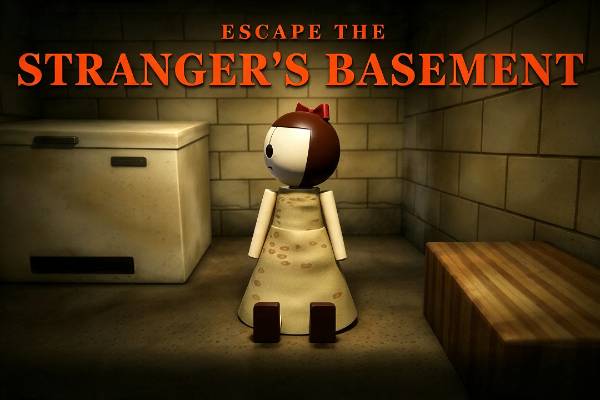
There are items that look "useless"—a doll sitting on a wooden box, a green toolbox with four knobs that you can't see any symbols on. New players often ignore them. But it's not useless. You need to rotate the doll. If you rotate it again when the lights go out, the symbols on the toolbox will appear. Rule: no item is "useless" in this game. If you can interact with it, it has a purpose. If you can't do anything with it now, that means you need to come back after a state change, or find another tool.
Effective Gameplay Strategy & When to Use Hints
- Step 1: Start with the blanket. Follow the chain of clues until it leads you to the electrical cabinet.
- Step 2: Once you have control of the electricity, try turning each device on/off. Observe what changes.
- Step 3: Hear all the radio messages. It is not just background noise. It contains useful information about the operation of the door lock.
- Step 4: If you get stuck, press Hint once to focus, but try to solve the rest yourself.
When you hit the Hint button, the game doesn't simply tell you the answer. The first time, it points to something you need to pay attention to. The second time, it tells you what to do with it. The third time, it gives specific details. That's a smart design because it saves the discovery and doesn't just give you the answer. Experienced players understand that if you get stuck, press Hint once. If it's still unclear, press again. But stop before it gives you the complete answer. This way, you still feel like you've solved the puzzle, not that the game has solved it for you.
Game Control Panel
Conclusion
Escape the Stranger's Basement is not a game you "win" by random searching. It's a game you "solve" by understanding that every element in the environment—from a jar to an electrical switch—has a purpose and is connected to the others. When you understand this, the game becomes less mysterious and more logical. You no longer feel stuck because you know what you're looking for—a connection you haven't yet seen.